
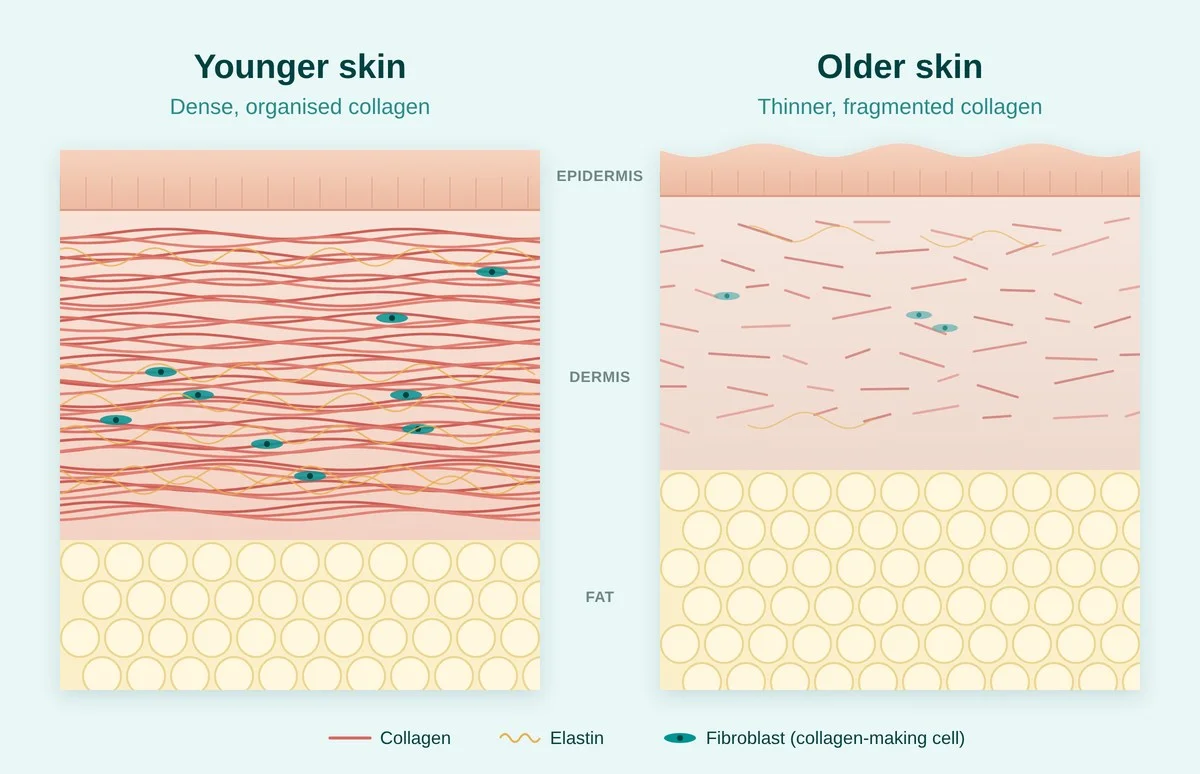
If there is one word I hear more than any other in consultation, it is “collagen”. Patients often tell me their skin looks tired, a little looser around the jawline, or that make-up sits differently than it used to. In most cases, what they are describing is the gradual loss of collagen that happens to all of us with time.
I’m Dr Ed Omarjee (MBBS Hons, FRACGP, FCPCA, FACAM). I have practised cosmetic medicine since 2006, full time since 2012, and I personally consult and treat every patient at The DOC Clinic in Hoppers Crossing and Ashburton. In this blog I want to explain what collagen actually does, why we lose it, and the low-downtime options I use to help the skin make more of it again. The medical term for this is collagenesis, or collagen production.
What collagen does, and why we lose it
Collagen is the main structural protein in the dermis, the deeper layer of the skin. Think of it as the scaffolding that keeps skin firm, smooth and resilient. Alongside elastin, which gives skin its bounce, and hyaluronic acid, which holds water, it is what makes young skin look plump and even.
From our mid-twenties, we produce roughly 1% less collagen each year. The collagen we do have also becomes more fragmented. Several things speed this up:
- Sun exposure, which is by far the biggest factor in Australia
- Smoking and pollution
- Hormonal changes, particularly after menopause, when collagen loss accelerates
- Poor sleep, high sugar diets and general lifestyle stress
- Genetics, which we can’t change but can work with
The good news is that skin keeps the ability to make new collagen throughout life. Our cells called fibroblasts simply need the right signal. Almost every treatment below works on the same principle: a controlled stimulus, usually gentle heat or micro-injury, that tells the skin to repair and rebuild.
Why I focus on low-downtime treatments
Most of my patients work, have families and don’t want to hide at home for a week. My approach is usually a course of gentler treatments, sometimes combined, rather than one aggressive procedure. The results build gradually over three to six months as new collagen forms, and they tend to look natural because they are your own tissue.
Exion RF microneedling
Exion combines very fine microneedles with radiofrequency (RF) energy delivered at a set depth in the skin. The needles create tiny channels, and the RF heats the dermis to trigger collagen remodelling. What I like about the Exion system is that it monitors the skin (via an AI algorithm) as it treats and adjusts the energy, which helps keep treatment consistent and comfortable. A topical anaesthetic is usually applied 1 hour pre treatment to ensure you are comfortable.
It is well suited to fine lines, crepey texture, enlarged pores and acne scarring. Expect some redness and mild swelling for a day or two. A typical course is three treatments about four to eight weeks apart. I will sometimes add Insulin or PRP (Platelet rich plasma) topically post the treatment to improve the whole collagenesis and healing process.
Exion Face – no needles
For patients who prefer to avoid needles altogether, Exion Face uses RF together with targeted ultrasound applied over the skin’s surface. It is designed to stimulate the skin’s own collagen and hyaluronic acid. There is no downtime at all, which makes it a good option for maintenance, for needle-shy patients, or as a starting point for younger skin. This treatment can also be used on t he lips to give a natural small increase in the lip volume. Other areas include around the eyes, cheeks, and forehead.
Traditional skin microneedling
Microneedling with a medical-grade pen, such as Dermapen, remains one of the most reliable and affordable collagen treatments. Thousands of tiny punctures start the skin’s wound-healing response, which lays down new collagen and elastin. It improves texture, fine lines, pores and mild scarring.
Recovery is usually one to three days of pinkness, similar to mild sunburn. It also helps the skin absorb serums applied straight afterwards.
Topical vitamin A
No in-clinic treatment works as well on its own as it does alongside good home care. Vitamin A, applied to the skin, is the best-researched topical ingredient for collagen. It comes in several strengths, from gentlest to strongest:
- Retinyl esters (such as retinyl palmitate), very gentle and suited to beginners and sensitive skin
- Retinol, the most common over-the-counter form
- Retinal (retinaldehyde), one step closer to the active form and faster acting
- Prescription-strength vitamin A, the active form itself, which is only available after a consultation
The stronger the form, the stronger the effect, but also the greater the chance of dryness and irritation. I cover vitamin A in much more detail in a separate blog.
Fotona 3D and 4D laser
The Fotona laser uses two wavelengths, Er:YAG and Nd:YAG, in a layered treatment that works on the skin from the inside out. Fotona 3D includes three steps:
- SmoothLiftin – the laser is used inside the mouth, which sounds unusual but is comfortable. It heats the tissue from within to tighten around the mouth and soften the nasolabial folds. It feels like a warm feeling, and not painful.
- FRAC3 – targets deeper skin imperfections, fine lines and pigment while stimulating collagen.
- PIANO – delivers gentle, deep heat through the skin to tighten and stimulate collagen across the face.
Adding a fourth step, SupErficial, a light laser peel that refreshes the surface, makes it the Fotona 4D. I often leave this step out in summer. Downtime is minimal: most people are a little pink for a few hours.
Laser Genesis with Cutera
Laser Genesis is one of the gentlest collagen treatments I offer. A 1064 nm laser is passed repeatedly over the skin to warm the dermis. Patients describe it as a warm, relaxing sensation. There is no downtime, and it suits all skin types, including darker skin. It helps redness, texture, pores and fine lines over a course of treatments. I perform it with both the Cutera Xeo and the Cutera Excel V+.
The Excel V+ also allows green Genesis, which uses the 532 nm wavelength. It treats redness, broken capillaries and fine pigment as well as stimulating collagen. Because this wavelength is absorbed by pigment, it is only suitable for very fair skin, Fitzpatrick types 1 and 2. This is exactly why a proper skin assessment matters before choosing a treatment.
If you can allow more downtime: Fraxel Dual
Most of this blog focuses on low-downtime treatments, but for patients who can take some time out, Fraxel Dual is a stronger option. It is a fractional laser with two wavelengths. The 1550 nm wavelength works deeper to stimulate collagen for fine lines, texture and acne scarring. The 1927 nm wavelength works closer to the surface to target sun damage and pigmentation.
The trade-off is downtime. Expect around five to seven days of redness, swelling and a dry, bronzed, flaking appearance as the skin renews. A course is usually three to five treatments about four weeks apart. It needs extra care in darker skin types because of the risk of pigment changes, so a skin assessment beforehand is essential.
Other options at The DOC Clinic
- Platelet-rich plasma (PRP), which uses growth factors from your own blood, either injected or combined with microneedling
- Bio rejuvenating treatment – an Italian-derived injectable product which is a combination of hyaluronic acid and cocktail of amino acids that increases collagen, elastin and hyaluronic acid production. This aims to give the skin more glow, and improve fine wrinkles and ageing skin (pigmentation and redness). TGA regulations prohibit me naming the specific brand.
- Healite 2 LED light therapy, which helps calm the skin and support healing after other treatments
Combining treatments for the best result
In practice, the best results come from combining approaches. A typical plan might be daily sunscreen and a vitamin A at home, plus a course of RF microneedling or Fotona in clinic, with Laser Genesis for redness and maintenance. Each treatment works at a slightly different depth, so they complement rather than repeat each other.
Results vary from person to person, and collagen takes time to build. Most people notice the full benefit three to six months after a course.
Book a consultation
Every skin is different. Skin type, colouring, medical history, budget and how much downtime you can manage all shape the right plan. If you’d like to talk through your options, book a consultation with me at DOC East in Ashburton or DOC West in Hoppers Crossing. I’ll assess your skin and give you an honest view of what’s realistic.


